.avif)
It usually happens on the second or third day. You're standing on the ice or sitting on the deck watching the white cliffs hold still on the horizon and something settles in your chest that you didn't know was unsettled. The wind moves over the water. A shelf of ice calves in the distance with a sound like a door closing in an empty house. And then there is nothing. Just the largest silence most of us will ever stand inside.
We've brought travellers to some of the most extraordinary places on earth. Antarctica is the only one that consistently does this makes people stop mid-sentence, look up, and go quiet themselves. As if the continent is asking something of you, and the only right answer is stillness.
Why does it feel like a luxury?
Our cities never fully sleep and the quieter towns closer to nature always carry this low hum. Whether it is distant motorways, aircraft at altitude or simply the neighbour's generator. The noise floor of modern life has risen so steadily that we have simply stopped registering it.
Until Antarctica takes it away.
"I didn't realise I was carrying it," a guest told us after her first afternoon on the ice about the uncatalogued tension of twelve months of urban sound. "I only knew it was gone when I couldn't feel it anymore."
This is the paradox at the heart of Antarctica's silence: you cannot understand what you've been missing until it is suddenly restored.
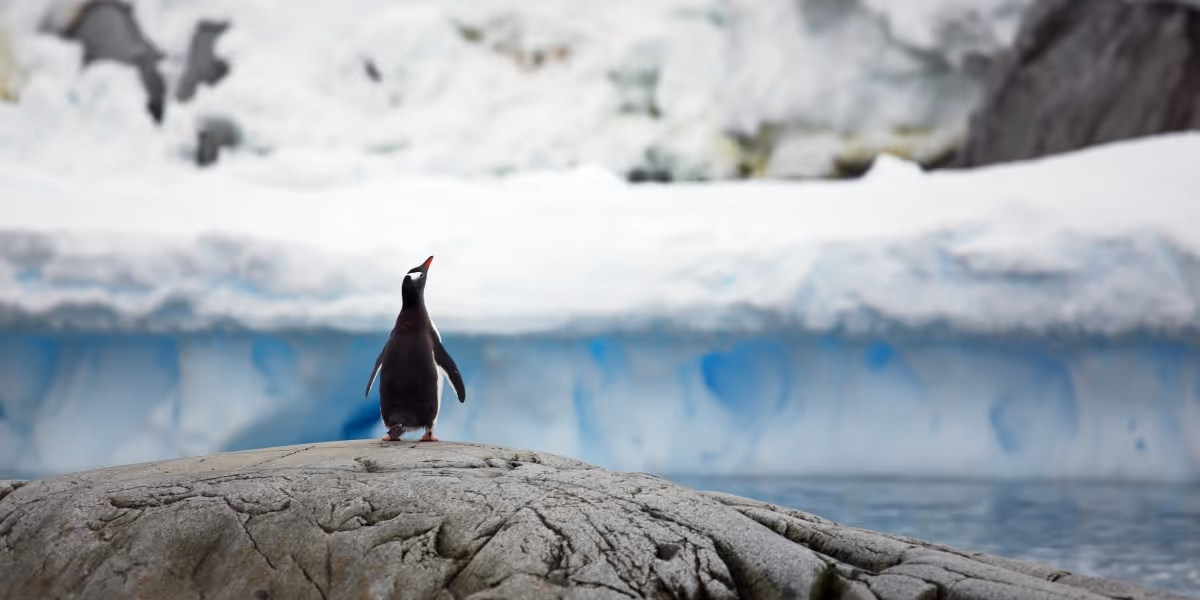
How does Antarctica do it?
The continent earns its quiet honestly. Antarctica only has rotating populations of scientists at research stations and the expedition voyagers who arrive between November and March, when the austral summer briefly experiences darkness. It is the world's highest continent, a place of geological extremes that has resisted permanent habitation through sheer remoteness. The Drake Passage, that notorious stretch of Southern Ocean between Tierra del Fuego and the Antarctic Peninsula, acts as a natural stretch, a two-day crossing that filters out the casual and confirms to the traveller that they have genuinely arrived somewhere other.
As the only Indian member of IAATO (the International Association of Antarctica Tour Operators) responsible travel in this ecosystem is something we take personally. The continent hosts only rotating populations of scientists and a carefully governed number of expedition voyagers each austral summer, between November and March. And it's why the kind of travel we bring you to is the only kind that belongs here.
Do you know the Attention Retention Theory actually applies to Antarctica?
There is a well-documented psychological phenomenon called Attention Restoration Theory, developed by environmental psychologists Rachel and Stephen Kaplan in the 1980s, which holds that natural environments replenish the directed-attention resources that modern life depletes. Wild places, the Kaplans found, allow the mind to shift into a softer mode of perception, one that restores rather than drains. Antarctica is, in this sense, the most potent restorative environment imaginable: vast and wholly removed from the structures of ordinary life.
Guests who have visited every significant wilderness on earth: the Serengeti at dawn, the Amazon in flood, the Himalayas above the clouds, consistently describe Antarctica as categorically different. More complete in its insistence that you are, for now, somewhere else entirely.
"It resets you," said a guest who had voyaged with us twice. "Not metaphorically. Actually resets you. I came home and slept properly for the first time in years."
Stillness, summoned by Antarctica
The luxury industry has spent decades trying to manufacture the conditions that Antarctica provides for free: the uninterrupted sleep, the detoxification from digital noise, the sensation of time slowing and deepening. Antarctica is simply still. The silence is not a programme or an amenity. It is the natural condition of one of the last places on earth that human noise has not yet reached.
"The people who've stood on that ice and heard that silence almost always come home changed in a specific way. They understand what is actually at stake in a way no documentary or classroom can replicate. The continent doesn't need advocates in the abstract. It needs people who have felt what there is to lose." - Rohan Prakash, Founder, UnWild Planet
This is part of why we do what we do. Responsible expedition travel, within the strict guidelines of the Antarctic Treaty, has built a global constituency of people who've stood on the ice and returned as guardians of something irreplaceable.
The wilderness doesn't need us there but some places are worth going to precisely so you understand why they must be protected.
Antarctica is one of them.
.avif)