There are few places left on Earth that resist human scale and Antarctica is one of them.
In summer, the sun circles endlessly above the horizon. In winter, darkness engulfs the continent for months. Winds exceed 200 km/h. Temperatures plunge below –40°C inland.
And yet, life thrives here.
At the heart of this frozen wilderness stands one of its most iconic inhabitants: THE PENGUINS.
To understand Antarctica deeply, you begin with a penguin’s journey.
Why Penguins Define the Antarctic Experience
Penguins are resilient, communal, evolutionarily precise and represent survival in its purest form. Observing their life cycle is one of the most profound wildlife encounters on Earth.
Among the most iconic Antarctic species are:
- Emperor penguin
- Adélie penguin
- Gentoo penguin
- Chinstrap penguin
- King penguin
Each species occupies different ecological niches and different expedition routes.
After seven expeditions to Antarctica, I’ve realized something fascinating: every visit reveals a new side of these birds. Not because the penguins change but because the more time you spend with them, the more their world begins to make sense.
And once you understand their rules, you realize we’re just visitors passing through their homes and end up picking a lesson or two.
Lesson #1: Obey the traffic rules
One of the first things you learn in a penguin colony is that you are never really walking alone.
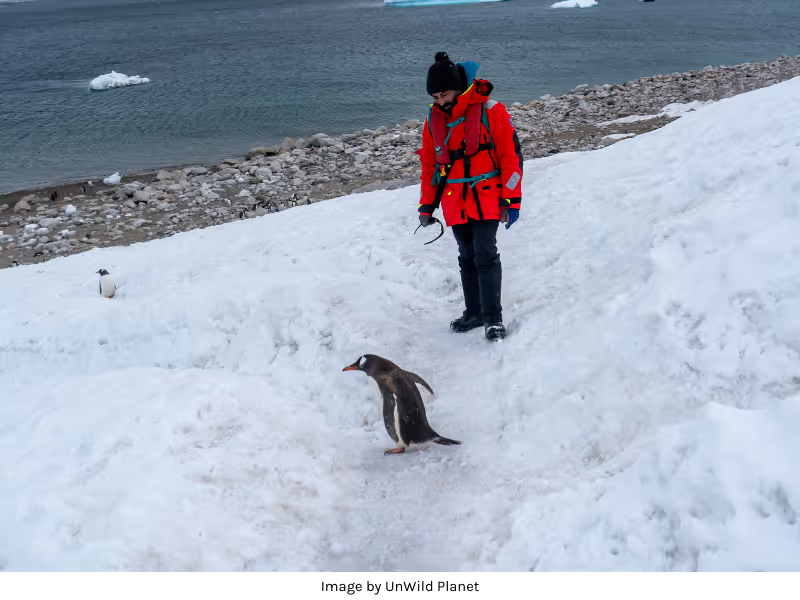
Penguins follow something researchers and guides often call “penguin highways.” These are narrow pathways carved into the snow by thousands of penguins waddling back and forth between the ocean and their nesting grounds.
At first glance they look random, just faint tracks across ice. But spend a few hours watching, and you’ll see they function exactly like roads.
Penguins use them with surprising discipline.
On one of my earlier trips, I watched a visitor unknowingly step right into the middle of one of these highways. He stopped to take photos, unaware that he had effectively blocked traffic.
Behind him stood a single penguin.
The bird simply waited.
For nearly two minutes it stood there, staring at him patiently. No attempt to go around. No agitation. Just waiting for the path to clear.
Eventually the visitor moved aside.
The penguin resumed walking like nothing had happened.
That moment taught me something important: penguins don’t break the rules of their roads. [Be like a penguin]. If the path is blocked and they can’t proceed, they’ll often just turn around and go back rather than detour.
It’s their highway. We’re the obstruction.
Lesson #2: Find What Matters in a World of Noise
Stand in the middle of a large penguin colony and you’ll hear something unforgettable - the noise ! Thousands of chicks crying, calling, begging for food. A constant chorus echoing across the ice.
It raises an obvious question: how does any parent find its chick?
Imagine trying to find your child in a stadium filled with thousands of babies all crying at once.
Yet penguins do it effortlessly.
The secret lies in vocal recognition. Each chick and each parent develops a unique call, almost like a vocal fingerprint. When a parent returns from the ocean after days of feeding, it calls out and its chick answers.
The two calls lock onto each other across the chaos.
Scientists have studied this phenomenon for decades, but witnessing it in person is something else entirely. You see a parent penguin standing still, calling repeatedly, while hundreds of chicks mill around.
Then suddenly one chick sprints toward it, just instant recognition in a sea of thousands.
It’s one of the most remarkable parent–child reunions you’ll ever see in the wild.
Lesson #3: Partnership Is Shared Burden
Among all penguin species, one behavior still amazes me every time I see it described or discussed, the breeding ritual of Emperor penguins.
The female lays a single egg during the Antarctic winter. But instead of incubating it herself, she passes it to the male. That transfer is one of the most delicate moments in the entire animal kingdom.
The egg cannot touch the ice. If it does, even briefly, the freezing temperatures could kill the embryo. So the female carefully nudges the egg onto the male’s feet while he balances it under a fold of warm skin called the brood pouch. It’s a slow, cautious exchange.
Once the egg is safely transferred, the female heads to sea to feed. The male stays behind.
For nearly 2 months, he will incubate the egg through the harsh Antarctic winter. No hunting. No food. Just enduring blizzards while huddling with thousands of other males to conserve warmth.
By the time the chick hatches, he’s lost a huge portion of his body weight.
Only then does the female return from the ocean, ready to take over feeding duties.
It’s a partnership built entirely on timing and trust.
Lesson #4: To Grow New Feathers, You First Have to Shed the Old
If there’s one stage in a penguin’s life that feels almost cruel, it’s molting.
Unlike most birds that gradually lose and replace feathers, penguins molt all at once in what scientists call a catastrophic molt.
Over a short period, their feathers loosen, fall out, and get replaced by new ones.
During this time, penguins look… rough. Patches of old feathers hang off their bodies. New ones push through underneath. They scratch constantly, shuffle awkwardly and spend most of their time standing around looking miserable.
But the real challenge is this:
They cannot enter the ocean.
Until the new waterproof feather layer is fully grown, swimming would mean freezing in the Antarctic waters. Which means they cannot hunt. So before molting begins, penguins gorge themselves at sea and build up massive fat reserves.
Then they come ashore and fast for weeks.
Watching this process up close, you realize how physically demanding survival here really is. Molting isn’t just uncomfortable, it’s painful.
Yet every penguin goes through it, year after year.
The longer you watch penguins, the more you realise their world isn’t so different from ours. In the middle of chaos, they find their own. In moments of vulnerability, they rely on partnership. And when the season demands it, they endure discomfort to emerge stronger.
Nature rarely teaches through speeches, it teaches through patterns.
On the ice fields of Antarctica, among thousands of identical black-and-white silhouettes, penguins quietly remind us of something we often forget in our busy lives: survival isn’t just about strength. It’s about patience and knowing when to step aside so life can keep moving forward.
Sometimes, the greatest travel stories aren’t about the places we visit but the lessons we carry back home.